
Penetration testing (pentesting) is essential for identifying vulnerabilities before attackers do. But despite advances in automation across other parts of the security workflow, one stage remains stuck in the past: reporting.
Manual pentest reporting is a time-consuming, error-prone process that quietly eats away at productivity, team morale, and even profit margins. For many security consultancies, internal security teams, and managed service providers (MSPs), the reporting phase can take as long (or longer) than the testing itself. And in a business where efficiency and scale is important, that’s a serious problem.
In this post, we’ll break down the real costs of manual reporting, explore how it impacts your business, and show you how modern tools like PentestPad can help eliminate this almost entirely.
The Time Sink You Didn’t Plan For
Let’s say your team has completed a five-day web application pentest. The testing went smoothly, and now it’s time to compile the final report. That means:
- Reviewing notes from multiple tools
- Manually writing vulnerability descriptions
- Copy-pasting screenshots into documents
- Formatting everything to match client branding
- Double-checking for consistency, grammar, and clarity
It’s not uncommon for reporting to take 2–3 full days of an experienced tester’s time. Multiply that across multiple projects and team members, and you’re losing dozens of billable hours each month to what is essentially a documentation exercise.
This doesn’t just delay delivery. It creates a backlog, extends turnaround times, and limits how many projects your team can take on.
The Business Impact: What Manual Reporting Actually Costs
Let’s look at where the cost really comes from:
- Lost Revenue When highly skilled testers spend a third of their time on formatting documents, you’re losing opportunities to take on additional clients. Every hour spent formatting is an hour not spent on value-added security testing.
- Inconsistent Quality Manual reporting varies based on who’s writing it. Some testers are excellent writers; others are less comfortable communicating technical details clearly. This inconsistency affects your brand, client satisfaction, and can even lead to misinterpretation of findings.
- Team Burnout Let’s be honest, no one becomes a pentester to format Word documents. Forcing high-value talent to do repetitive, low-value tasks leads to frustration and disengagement.
- Client Trust & Credibility Poorly formatted or inconsistent reports hurt your credibility. Clients expect professionalism not just in how you find vulnerabilities, but how you communicate them. Mistakes or delays have an impact on trust.
Why Traditional Fixes Don’t Go Far Enough
Some teams try to patch the problem with checklists, shared templates, or Excel-based tracking. While these can help with consistency, they still require manual effort, and worse, they often introduce new failure points:
- Template versioning issues
- Copy-paste errors
- Lost context between testing and reporting
- No centralized view of project progress
This creates a faulty process that doesn’t scale easily.
The Case for Automating Pentest Reporting
Modern security teams are ready to work smarter. Automating your reporting process isn’t just about saving time - it’s about being efficient across your entire workflow.
Here’s what an ideal solution should offer:
- Reusable vulnerability templates with auto-filled fields
- Screenshot and evidence auto-injection
- Client-branded report generation in one click
- Real-time collaboration between team members
- Status tracking for report sections (e.g., Draft, Review, Complete)
This is where PentestPad report generation comes in.
How to Eliminate Reporting Pain
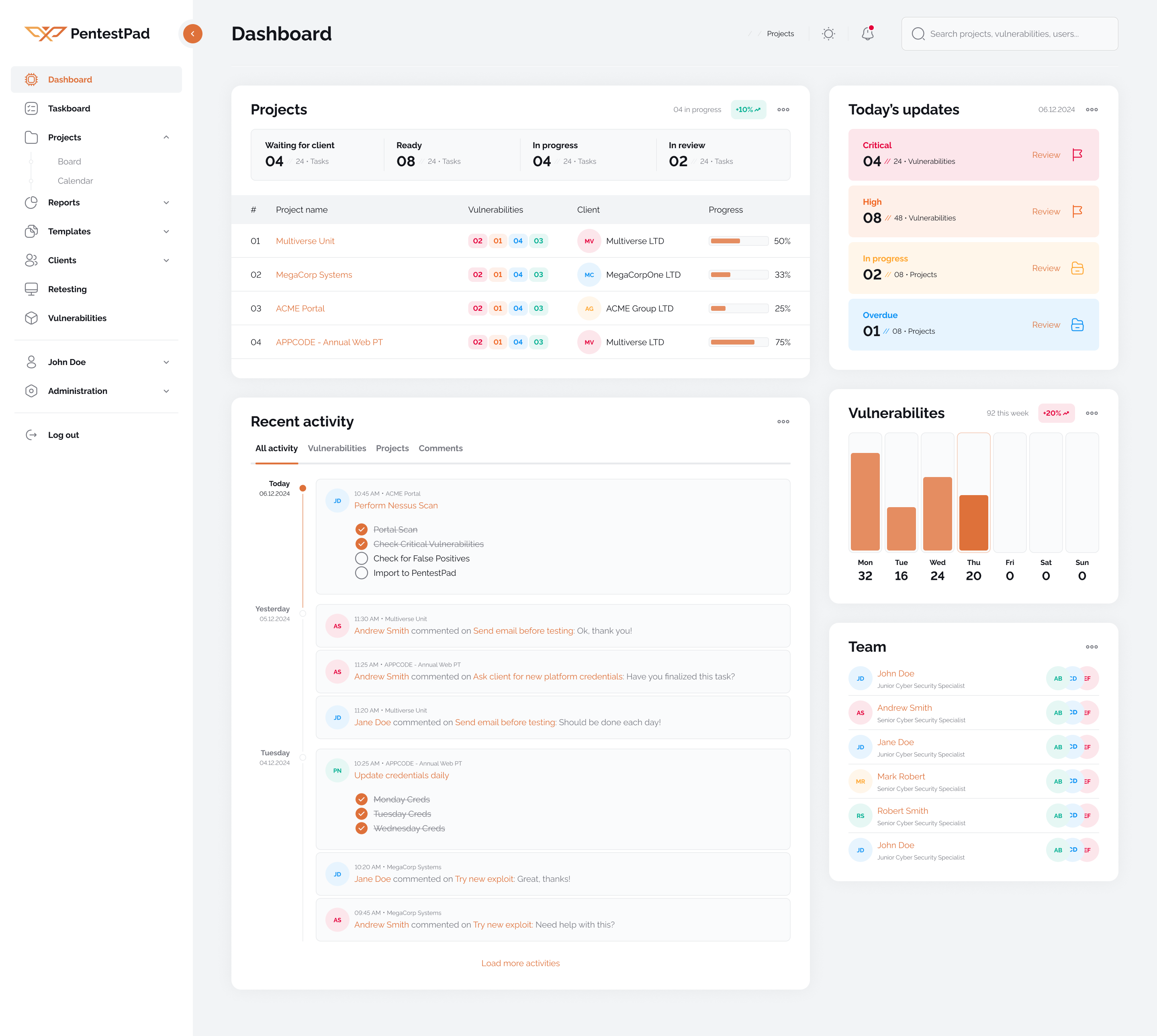
PentestPad was built specifically for pentesters - by pentesters. It solves the reporting problem at its root, with features designed to automate whatever is possible.
1. Custom Vulnerability Templates
Build and reuse high-quality finding templates that auto-fill descriptions, CVSS scores, risk levels, remediation steps, and references. This ensures consistent, professional output - regardless of who’s doing the writing.
2. Project Management + Reporting Integration
With a Kanban-style board, each vulnerability can be tracked through testing, review, retesting, and reporting. Your team can see exactly what’s done, what’s pending, who to ask and what needs attention.
3. Evidence Attachment + Auto-Insertion
Upload screenshots and proof-of-concept code directly to the finding, and PentestPad takes care of formatting it neatly in the final report. No more dragging images into Word. Finding templates are reusable as well.
4. Automated Report Generation
Generate clean, client-ready reports with a single click - using your own custom branding, templates, and preferred formats (PDF, DOCX, HTML). Last-minute changes? Easy edits, no reformatting needed.
5. Automated Retesting
Generate retest reports simply by checking and unchecking vulnerabilities that have been fixed, and watch how your new report is automatically generated based on the original one.
6. In-Tool Collaboration
Review findings, assign sections, and comment in real time. No more switching between Slack, email, and spreadsheets.
🔻 ROI You Can Feel
Let’s quantify the benefits:
- Save 10+ hours per tester per engagement
- Deliver reports 2–3x faster
- Increase capacity for billable projects
- Improve report quality and client satisfaction
- Reduce tester burnout and turnover
For consultancies and internal security teams alike, that’s a major competitive edge.
Manual pentest reporting is often considered a “necessary evil.” But it doesn’t have to be. By automating the most repetitive and time-consuming parts of the process, your team can focus on what they do best: finding and fixing security vulnerabilities.
PentestPad helps you do exactly that - while looking more professional, delivering faster, and scaling your business.
Ready to eliminate reporting headaches for good? Try PentestPad for free or schedule a demo.
About PentestPad
PentestPad is a collaboration and reporting platform for penetration testing teams. Built by pentesters, it helps you manage projects, track vulnerabilities, streamline communication, and generate high-quality reports effortlessly.